
BlogMoney · 4 min read
How to Price Homemade Food: 6 Numbers Most Cooks Skip
Most home cooks price by what the neighbours charge. Six numbers, from packaging to your own hour, that show what a dish really costs to sell.
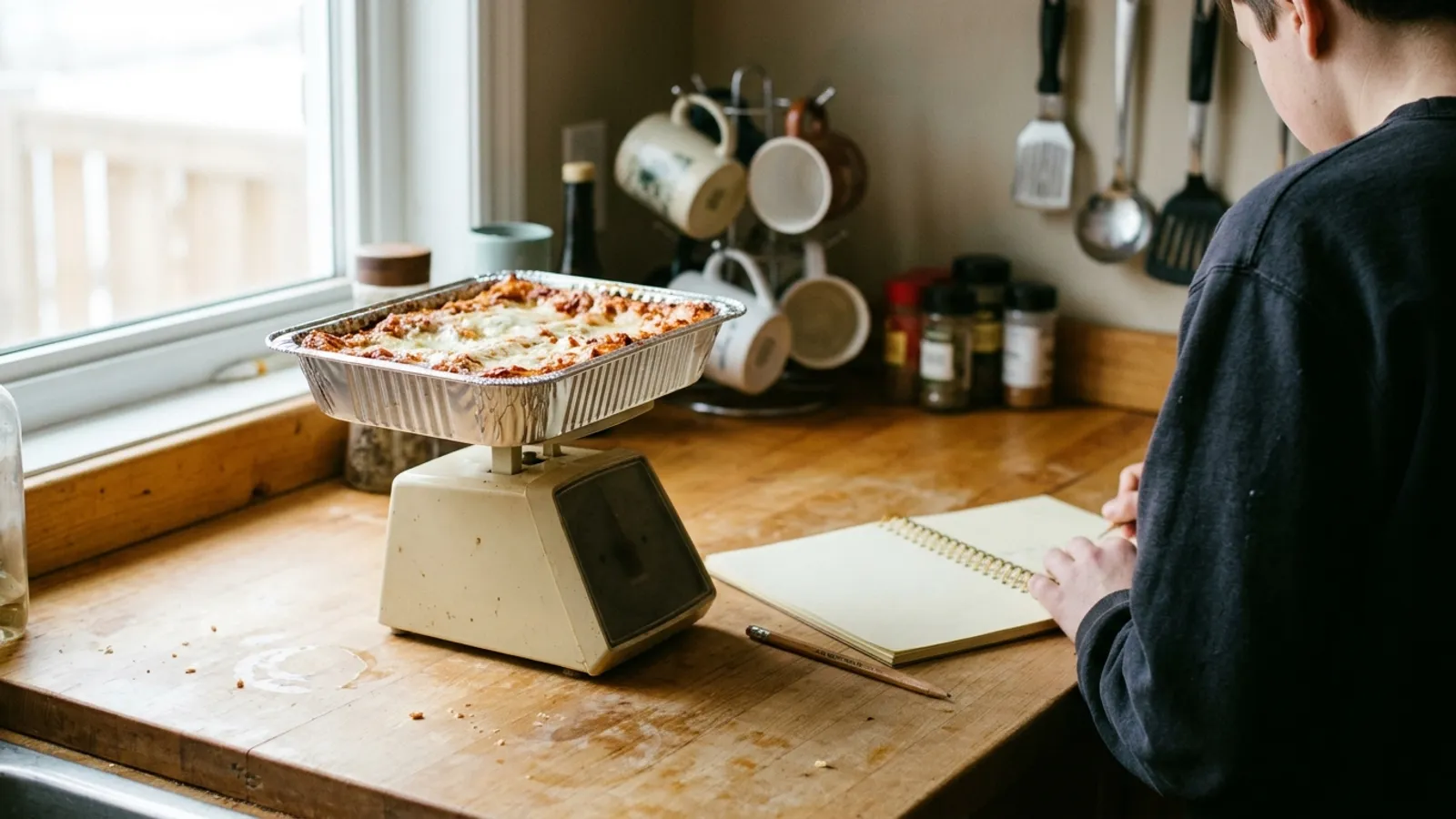
Picture a lasagna that sells for $42 a tray and leaves about $8 once every cost is counted. Its maker is not bad at business. She priced it the way nearly everyone does at first: a little above the ingredients, a little below the shop down the road.
A price is a sum, and most home cooks leave out half the terms. Here are the six numbers that go into it, with one tray worked through from start to finish. The example is invented, but the arithmetic is the kind you can do tonight with your own receipts.
General information, not legal advice
1. Ingredients, per portion and to the gram
The grocery bill is the number everyone knows and almost nobody divides properly.

Cost the recipe, not the shopping trip. A $9 block of cheese that covers three trays is $3 a tray. Do it for every ingredient, including the oil, the spices and the half onion. In our example the tray comes to $14.50 in ingredients.
Redo this sum every few months. Prices move, and a recipe costed last winter is a different recipe now.
2. The box it leaves in
Packaging is the cost that hides in a cupboard.
The tray, the lid, the label, the bag and the napkin all leave with the customer. Bought in bulk they feel free; counted per order they are not. Our tray's packaging comes to $1.75.
3. Your hour
If the price does not pay you, you have a hobby with customers.
Time the whole job once, honestly: shopping, prep, cooking, packing, cleaning and the messages. Divide by the number of trays in the batch. Then choose an hourly figure you would accept from an employer and multiply.
Say the batch works out to 45 minutes a tray and you value your time at $20 an hour. That is $15 of labour in every tray, and it is the number most often left at zero.
4. What it costs to be paid
Fees are small per order and large per year.
If customers pay by card, a common rate is 2.9% plus 30 cents. On a $42 tray that is $1.52. If you deliver, add what the trip costs you in fuel and time, or charge a delivery fee that covers it.
These costs are worth paying when they save you an evening of chasing transfers. They still belong in the sum.
5. The tray nobody bought
Some food will be dropped, burnt, or left over, and the price has to carry it.
Add a small allowance for waste: a dish that fails, a portion that does not sell, the sauce left in the pot. Five percent of ingredients is a modest place to start, which is 73 cents on our tray. Pre-orders with a cut-off shrink this number, because you cook what was ordered.
6. The margin, and the $30,000 line
Add it up, then decide what the business itself should earn.
Our tray costs $33.50 before any profit: $14.50 ingredients, $1.75 packaging, $15.00 labour, $1.52 in fees and $0.73 for waste. At $42 it leaves $8.50 for the business, to cover equipment, a slow week and growth. If that feels thin, the answer is a higher price, a bigger batch or a cheaper recipe. It is not working for free.
One more number sits in the background. The Canada Revenue Agency does not require you to register for GST/HST while your revenue is $30,000 or less over four consecutive calendar quarters. If you are heading towards it, plan your prices with that in mind and talk to an accountant.
- Ingredients: $14.50
- Packaging: $1.75
- Your time, 45 minutes at $20 an hour: $15.00
- Card fee on $42: $1.52
- Waste allowance: $0.73
- Total cost: $33.50. Price: $42.00. Left for the business: $8.50
Questions people ask
How much should I charge for homemade food?
Enough to cover ingredients, packaging, your time, payment fees and some waste, with a margin on top. Work it out per portion from your own receipts. What others charge tells you what customers are used to, not what your food costs to make.
Should I pay myself an hourly wage?
Yes, in the sum at least. Choose a figure you would accept from an employer and include it in the cost of every dish. A price that only works when your time is free will not survive a busy month.
Do I need to add HST to my prices?
Not while you are a small supplier. The Canada Revenue Agency does not require registration for GST/HST if your revenue is $30,000 or less over four consecutive calendar quarters. Once you pass that, you must register. Ask an accountant how it applies to what you sell.
How do Dish.ly's fees fit into my pricing?
On card orders the seller pays a 2.9% + $0.30 processing fee, which is the fee in the example above. There is no monthly fee. The customer pays a separate $2.00 service fee per order, so it does not come out of your price. Orders paid to you by Interac e-Transfer carry no card fee.
KNOW YOUR NUMBERS
See what you take home each week
Dish.ly shows what each order paid and what you receive after fees, and its calculator estimates a normal week before you start. There is no monthly fee.
Create my order page